




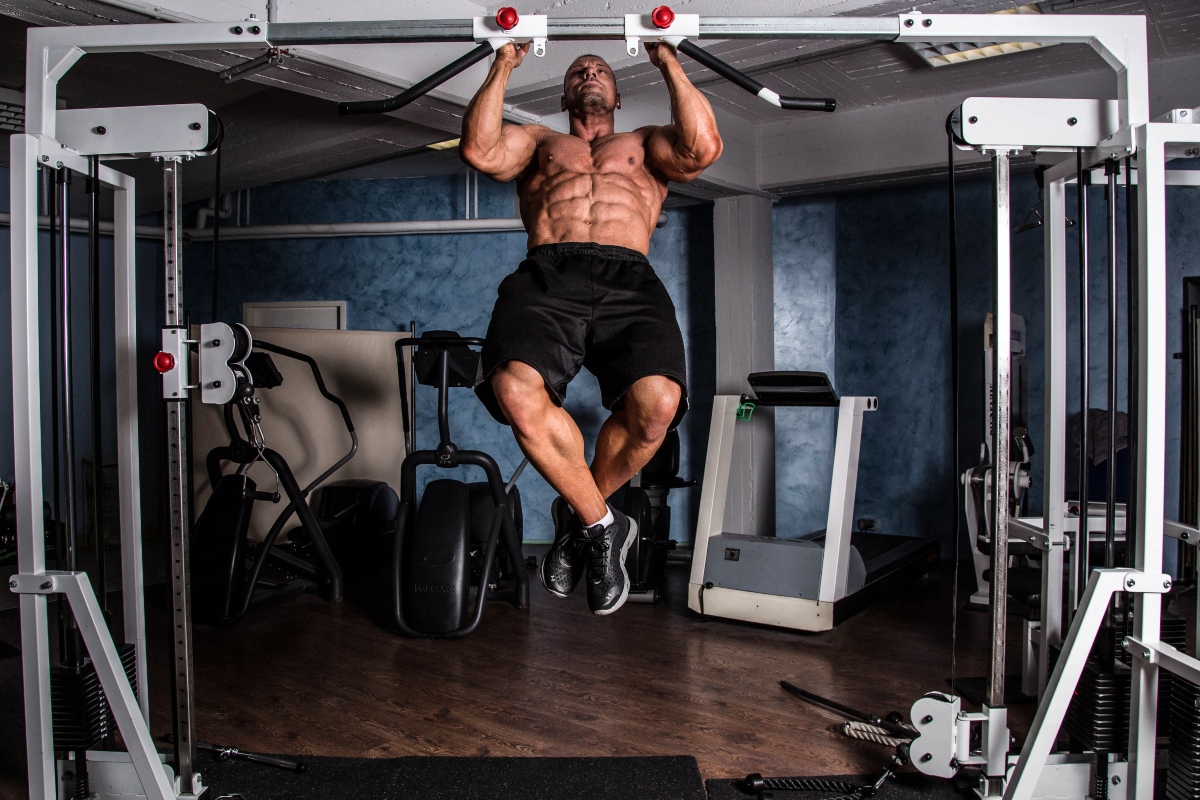
Chest exercises are important for developing the upper body and having a harmonious physique.
The pectoral muscles are among the most visible muscles that all men who practice bodybuilding try to develop because they are synonymous with power and strength. But it’s not just about aesthetics: having sculpted pectorals also represents an advantage in practicing many sports.
To develop the chest and tone the pectoralis major, pectoralis minor, and coracobrachialis muscles that make up the chest muscles, there are excellent chest exercises to do with or without equipment, at home or in the gym.
To grow the pectoralis major (the main and most voluminous part of the pectoral muscle), you need multi-joint chest exercises, performed with progressive loads and proper technique.
The most recommended chest exercises for hypertrophy of the pectoralis major to do in the gym are definitely the flat bench press with a barbell or the chest press, while if you train at home you can do chest exercises with dumbbells or bodyweight exercises like push-ups.
For an effective training plan, the advice is to train your pectorals 3 times a week. Discover the best exercises to do in the gym and a home chest workout.
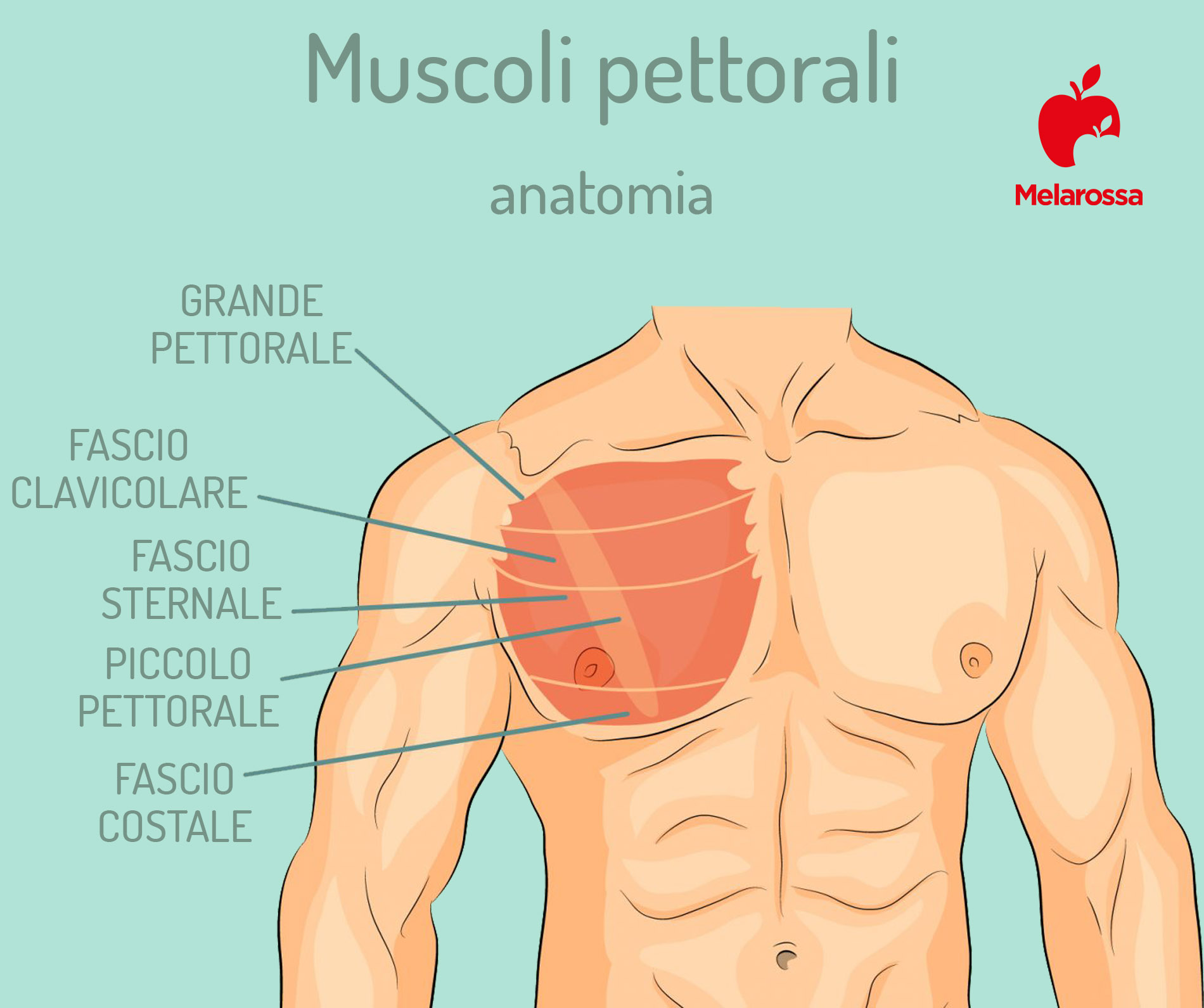
Anatomy of the Pectoral Muscles
The pectoral area is composed of 4 muscle groups called the “pectoralis major” (the most voluminous), “pectoralis minor” (located under the pectoralis major), serratus anterior, and subclavius muscle.
They extend from the ribs and sternum to the bones of the thoracic girdle and humerus.
Pectoralis Major in Men and Women
The pectoralis major is a large, triangular muscle located in the anterior part of the chest. It extends from the humerus and fans out to the clavicle, sternum, and ribs.
In men, it is covered by fibrous and subcutaneous tissue, while in women, it forms the base of the breast, which rests on it thanks to specific ligaments. The breast does not have actual muscles, except for small muscles near the milk ducts and nipple.
The pectoralis major enables arm movements (flexion, adduction, internal rotation) and also helps with trunk extension and forced breathing, lifting the ribs to facilitate air intake.
If you’re interested in the topic, discover the fitness circuit to firm up your breasts.
Pectoralis Minor
The pectoralis minor, on the other hand, located behind the pectoralis major but still in the anterior thoracic area, near the axillary region, is a muscle that originates at the level of the third to fifth ribs and extends to the scapula.
Its function involves scapular movements (abduction, rotation, and depression) and partially forced breathing.
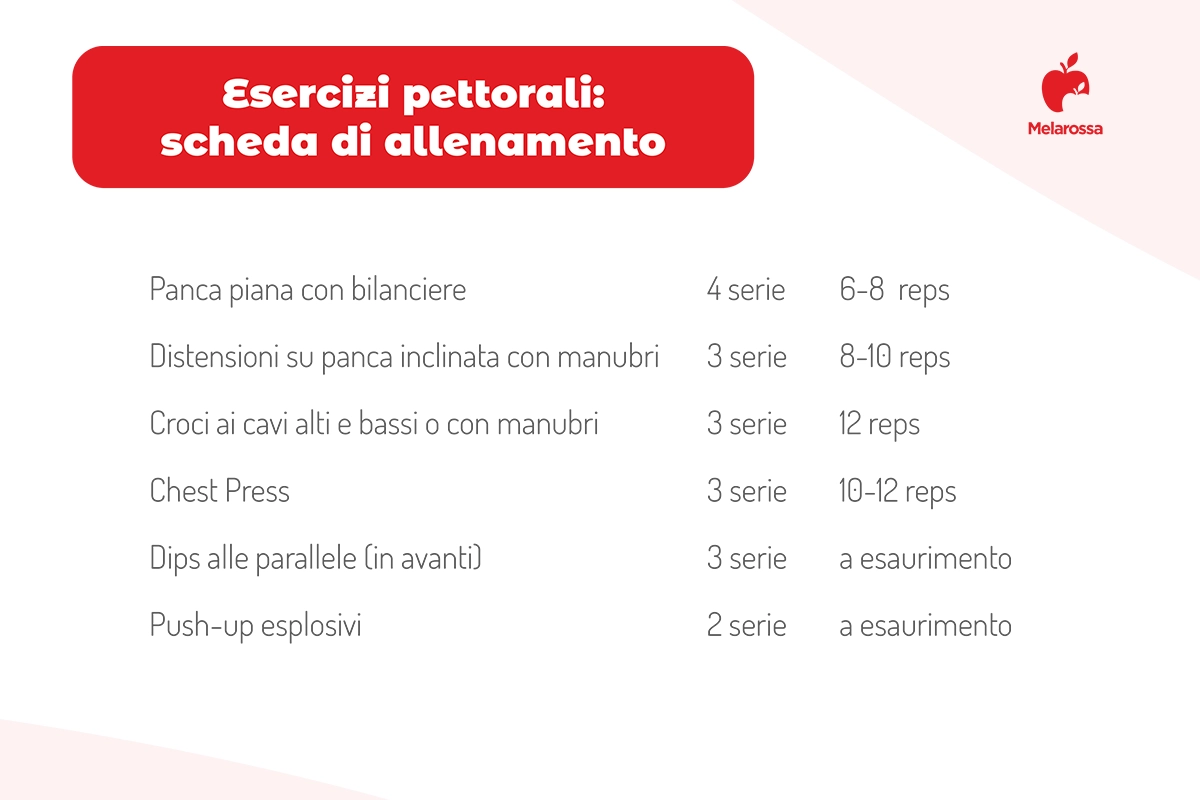
The Best Chest Exercises in the Gym: Workout Plan (3 Times/Week)
GOAL: muscle mass and definition of the pectoralis major.
Proposed workout with the best exercises for pectorals: Monday, Wednesday, and Friday.
| Exercise | Sets | Repetitions |
| Flat bench press with barbell | 4 | 6-8 |
| Incline bench dumbbell presses | 3 | 8-10 |
| Cable flyes (high and low) or with dumbbells | 3 | 12 |
| Chest Press | 3 | 10-12 |
| Parallel bar dips (leaning forward) | 3 | to failure |
| Explosive push-ups | 2 | to failure |
Rest: 60-90 sec between sets.
Tip: increase the weight when you can easily complete all sets.
Sculpted Chest at Home: Bodyweight Chest Exercises
You can perform calisthenics exercises that you can adapt to your level such as push-ups and dips between 2 chairs.
Growing your chest at home without weights is absolutely possible, using bodyweight exercises that leverage your body weight and variations to increase difficulty. The secret is to work with intensity, control, and progression.
Aim for muscle failure: perform each set until you feel real fatigue. Progressively increase the difficulty (more repetitions, more complex variations).
Train your chest with chest exercises 2-3 times a week, allowing at least one day of recovery.
- Classic push-ups: work the entire chest, triceps, and anterior shoulders. Keep your body straight and lower until you almost touch the floor.
- Incline push-ups (hands on elevated surface): easier, ideal for beginners.
- Decline push-ups (feet on elevated surface): tone the upper chest, more difficult to do.
- Explosive push-ups (with hand clap or fast): for those with an advanced level.
- Isometric or slow push-ups: hold the low position for several seconds or perform very slow movements to increase effort.
- Dips between two chairs (for those who can do them safely): excellent for developing the pectoralis major and triceps.
Chest Exercise Workout Program to Do in the Gym and at Home
The most important aspect for developing your pectorals is repetitions. Therefore, the last repetition you perform should exhaust the muscle fibers; if this doesn’t happen, it means you’re not working effectively.
The program includes 10 repetitions for each exercise, so it’s important to calibrate the weight of the dumbbells or barbell based on your athletic preparation, so that you have a load that allows you to reach 9 repetitions without difficulty. You can perform the chest exercises with dumbbells or a barbell.
Between one set and another, take a 30-second break, and between exercises, a 60-second break.
1 – Wall Push-Up
Muscles involved: arms, pectorals, and shoulders.
Start standing, with your body aligned and feet slightly apart, in front of a step or piece of furniture (about 1 meter away). While inhaling, rise onto your toes and bring your arms forward until they rest on the step in a plank position.
Bend your arms bringing your chest closer to the step, then exhale and push to return to standing, always keeping your body straight.
The higher the support, the easier the exercise. Avoid lifting your hips during the rise.
Sets: 5 sets of 10 repetitions.
2 – Parallel Bar Dips
Muscles involved: pectoralis major, triceps, core.
Grip the parallel bars and lift yourself off the ground. While suspended with your arms straight, slightly bend your knees (depending on your height and the height of the bars) and bring your feet backward. Inhaling and contracting your core muscles, bend your elbows and lower yourself with control, bringing your chest forward to stretch the pectorals, until you feel a stretching sensation, without ever bending your arms more than 90 degrees.
Exhaling, grip the bars firmly and push to rise back to the starting position.
Sets: 5 sets of 10 repetitions.
3 – Decline Push-Up
Muscles: pectorals (clavicular portion of the pectoralis major), rectus abdominis, triceps, and core.
Start in a plank position with your feet resting on a bench. Your body should be straight like a board, arms extended and hands at shoulder width or slightly wider. Inhaling, bend your arms and bring your chest closer to the floor, then exhaling return to the plank position with arms extended.
Always keep your gaze directed at the floor so that your neck and torso are aligned. Your back should be straight, in line with your legs: be careful not to arch it when bending your arms.
Sets: 5 sets of 10 repetitions.
4 – Bench Press
Muscles: pectoralis major, pectoralis minor, triceps, anterior deltoid.
Lying on your back, head, shoulders, and glutes resting on the bench, legs apart and bent at 90 degrees with feet firmly on the floor.
Grip the dumbbells, arms extended and perpendicular to the floor. Inhale and slowly bend your arms to bring your elbows beyond the bench. Exhaling, extend your arms and bring them closer to the center without letting the dumbbells touch each other. Pause for 5 seconds and repeat the descent.
Be careful to move only the upper part of your body and to keep your back firmly against the bench.
Sets: 5 sets of 10 repetitions.
5 – Butterfly
Muscles involved: anterior deltoid, pectorals.
Lying on your back, head, shoulders, and glutes resting on the bench, and legs apart and bent at 90 degrees with feet firmly on the floor. Keep your back well-supported on the bench throughout the exercise.
Grip 2 dumbbells, palms facing inward, and bring your arms extended above your head. Inhaling, open your arms outward and, keeping them extended, try to bring them parallel to the floor to stretch the pectorals. Exhaling, bring your arms back up. Repeat.
During the descent and ascent, your arms should always be in line with your shoulders. Don’t excessively extend the pectoral during the descent phase to avoid injury.
Sets: 5 sets of 10 repetitions.
6 – Dumbbell Pullover
Muscles: pectoralis major and latissimus dorsi.
Hold a dumbbell in your hands and position yourself perpendicular to a bench, supporting only the upper part of your back. Legs bent and open to hip width and feet firmly on the ground.
Hips raised so that your back is parallel to the floor. Bring the dumbbell up, arms extended. During execution, always keep glutes and legs contracted. Inhaling, bring the dumbbell behind your head with semi-extended arms and exhaling bring the dumbbell back in front of your chest.
Be careful not to arch your lower back. If you have cervical issues, you can do the pullover with your head and back supported on the bench.
Sets: 5 sets of 10 repetitions.
Stretching for Pectorals
Stretching at the end of your workout helps keep muscles flexible and prevents injuries.
The principle of stretching must always be respected: stretch the muscle until you feel a pleasant sensation, never painful, and hold the position for at least 30 seconds while breathing deeply.
Here’s an example of an exercise you can do: start standing, with a wall to your right. Leave a space of a few centimeters between you and the wall. Inhale and exhaling, keep your stomach in and extend your right arm backward, resting your hand on the wall.
Slowly rotate your torso outward until you feel the stretch in your shoulder.
Hold the position for 30 seconds, then turn to the other side and repeat the exercise with your left arm.
Conclusions
Training with chest exercises doesn’t necessarily require gym equipment: even at home, with bodyweight exercises and calisthenics, you can achieve concrete results in terms of strength, definition, and muscle growth.
The important thing is to choose the right movements, execute them with proper technique, and focus on progression and consistency.
Whether you’re a beginner or advanced, including variations of push-ups, dips, isometric exercises, and controlled movements in your chest exercises will allow you to stimulate all portions of the pectoralis major to grow your chest.
Work hard, listen to your body, and give your muscles time to adapt. Results will come, even without weights.
Source
- Effects of a High-Volume 7-Week Pectoralis Muscle Stretching Training on Muscle Function and Muscle Stiffness.